Al Haider Healthcare 🏥

World Leprosy Day 2026: Awareness, Early Diagnosis, Treatment & Ending Stigma
World Leprosy Day, observed on January 30, highlights that leprosy is a curable disease. Learn about its causes, symptoms, early diagnosis, treatment, and the importance of ending stigma at AHC Hospital.
Dr. Afzal Ali
1/30/20263 min read
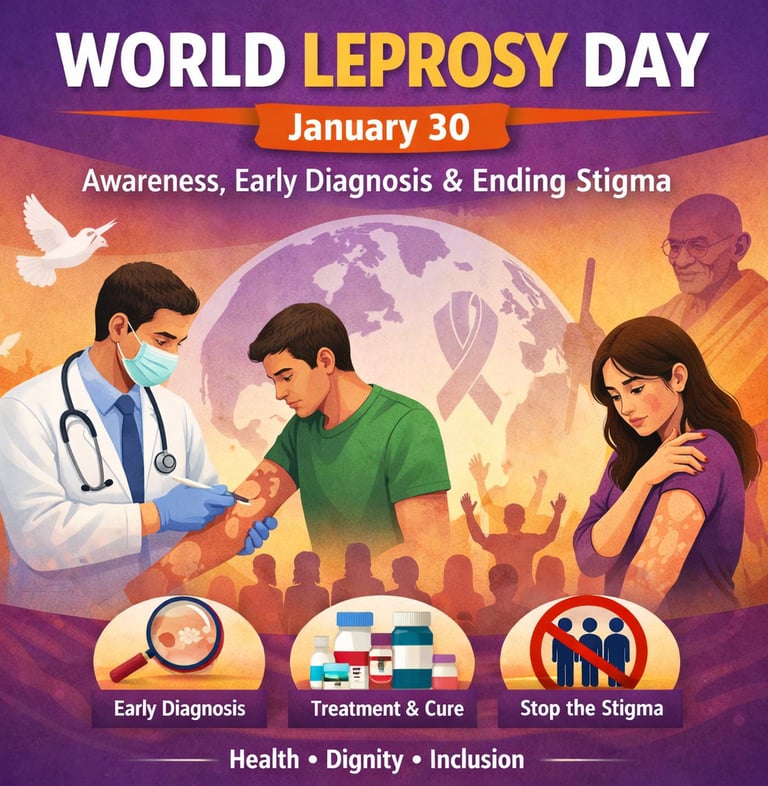
World Leprosy Day: Ending Stigma, Promoting Early Diagnosis, and Ensuring Dignity for All
How Does Leprosy Spread?
Leprosy is not highly contagious. It spreads through:
Prolonged close contact with untreated patients
Droplets from the nose and mouth
Important facts:
Casual contact (handshakes, sharing food, sitting together) does not spread leprosy
Over 95% of the population has natural immunity
Once treatment starts, the patient does not transmit the disease
Signs and Symptoms of Leprosy
Early symptoms are often subtle and painless, which is why diagnosis is delayed.
Common symptoms include:
Light-colored or reddish skin patches with loss of sensation
Numbness or tingling in hands and feet
Thickened peripheral nerves
Muscle weakness
Non-healing wounds
Loss of eyebrows or eyelashes (in advanced cases)
Early detection prevents disability and ensures complete cure.
Types of Leprosy
Clinically, leprosy is classified based on immune response:
Paucibacillary (PB) Leprosy
Fewer skin lesions
Low bacterial load
Multibacillary (MB) Leprosy
Multiple lesions
Higher bacterial load
Greater risk of nerve damage
Diagnosis of Leprosy
Diagnosis is based on:
Clinical examination of skin and nerves
Sensory testing
Skin smear or biopsy (if required)
At AHC Hospital, emphasis is placed on clinical screening and early referral to prevent complications.
Treatment: Leprosy Is Completely Curable
Leprosy is treated using Multi-Drug Therapy (MDT), recommended by the World Health Organization (WHO).
Key points about MDT:
Provided free of cost by national programs
Duration:
PB leprosy: 6 months
MB leprosy: 12 months
Safe and effective
Prevents transmission and disability
Once treatment begins, patients can live a normal and productive life.
Leprosy and Stigma: The Real Challenge
The biggest challenge today is not medical, but social.
People affected by leprosy often face:
Social rejection
Loss of employment
Psychological trauma
Delayed treatment due to fear and shame
Important message:
Leprosy is a disease, not a curse.
Discrimination violates human dignity and basic human rights.
Role of Public Health and Community Awareness
India runs the National Leprosy Eradication Programme (NLEP) with the goal of early detection and zero disability.
Key public health strategies include:
Community screening
Contact tracing
School health education
Training of frontline health workers
Rehabilitation and social inclusion
Community participation is essential to break myths and end stigma.
Role of AHC Hospital
At Al Haider Healthcare (AHC Hospital), we are committed to:
Early identification of skin and nerve disorders
Timely referral and treatment guidance
Patient counseling and stigma reduction
Community health education
Supporting national leprosy elimination efforts
Our goal is not only treatment, but also restoring dignity and confidence to every patient.
Why World Leprosy Day Matters
World Leprosy Day reminds us that:
Leprosy still exists
Early diagnosis saves lives and limbs
Stigma delays treatment
Compassion heals beyond medicine
By spreading awareness, we move closer to a world free from leprosy and discrimination.
Conclusion
Leprosy is curable, preventable, and manageable—but only when detected early and treated without fear or stigma. On this World Leprosy Day, let us pledge to:
Promote awareness
Encourage early treatment
Reject discrimination
Support affected individuals
Together, we can ensure health, dignity, and equality for all.
References
World Health Organization (WHO). Leprosy (Hansen’s disease) – Fact Sheet.
National Leprosy Eradication Programme (NLEP), Ministry of Health and Family Welfare, Government of India.
CDC (Centers for Disease Control and Prevention). Leprosy Overview.
International Federation of Anti-Leprosy Associations (ILEP).
Park K. Textbook of Preventive and Social Medicine, Leprosy Chapter.
Introduction
World Leprosy Day is observed every year on January 30, the death anniversary of Mahatma Gandhi, who dedicated much of his life to serving people affected by leprosy. This day serves as a global reminder that leprosy is curable, yet thousands of people continue to suffer due to late diagnosis, social stigma, and lack of awareness.
Despite major medical advances, leprosy remains a public health concern in several developing countries, including India. On World Leprosy Day, AHC Hospital reaffirms its commitment to awareness, early detection, treatment, and elimination of discrimination against persons affected by leprosy.
What Is Leprosy?
Leprosy, also known as Hansen’s disease, is a chronic infectious disease caused by Mycobacterium leprae. It primarily affects:
Skin
Peripheral nerves
Upper respiratory tract
Eyes
If not treated early, leprosy can lead to nerve damage, deformities, disability, and social exclusion.
© 2025. All rights reserved.
Subscribe to our newsletter
Contact Us
Visit Al Haider Healthcare for primary healthcare services and expert medical care.
Location
Semri-Sathi, West Champaran, Bihar, India 845449
Hours
OPD 9 AM - 9 PM
24*7 Emergency Sevice
Mob;
alhaiderhealthcare@gmail.com
+91-9060198636
Email;
www.ahchospital.in
Web;