Al Haider Healthcare 🏥

Role of DHA in Children: Brain Development, Learning & Daily Health
DHA is essential for early brain growth, learning ability, vision, and immunity in children up to 3 years. Expert pediatric guidance by Al Haider Healthcare.
Dr. Afzal Ali
1/28/20263 min read
Role of DHA in Developing Children: Brain Growth, Learning & Daily Health
Early childhood—from birth to 3 years—is a critical window for brain development, learning ability, and overall physical growth. Nutrition during this phase has a lifelong impact. Among essential nutrients, Docosahexaenoic Acid (DHA), a long-chain omega-3 fatty acid, plays a central and scientifically established role in brain maturation, vision, cognition, and day-to-day health.
👶 Role of DHA in Brain Development
During early life, the brain undergoes rapid growth, forming millions of new neural connections daily. DHA supports this process by:
Enhancing neuronal membrane fluidity
Improving synaptic transmission
Supporting myelination of nerve fibers
Aiding visual and retinal maturation
The AAP highlights DHA as critical for normal brain and eye development, particularly in the first years of life.
📘 DHA and Learning Ability
Adequate DHA intake has been associated with:
Improved memory and attention
Better learning capacity
Enhanced cognitive and behavioral outcomes
Studies reviewed by pediatric nutrition experts indicate that DHA plays a role in neurotransmission and higher cognitive functions, which directly influence learning and school readiness.
The CDC also reports that omega-3 fatty acid intake, including DHA, is often below optimal levels in children, potentially affecting cognitive performance.
🛡️ DHA in Daily Health and Immunity
Beyond brain and learning benefits, DHA contributes to:
Immune system modulation
Anti-inflammatory balance
Healthy cardiometabolic function
Maintenance of cellular integrity
The ICMR–National Institute of Nutrition (NIN) recommends balanced fat intake and inclusion of omega-3 fatty acids as part of healthy childhood nutrition in India.
📊 Recommended DHA Intake (Up to 3 Years)
Although no single authority defines a fixed RDA for DHA alone, expert bodies provide practical intake guidance:
Infants (0–12 months):
~100–200 mg DHA/day (via breast milk or fortified formula)Toddlers (1–3 years):
~200–300 mg DHA/day (DHA ± EPA), especially if dietary fish intake is low
The WHO, AAP, and CDC acknowledge that many children do not meet these levels through diet alone.
🐟 Indian Food Sources of DHA
Direct DHA Sources (Best Bioavailability)
Fatty fish: Bangda (mackerel), Hilsa, Sardines, Anchovies, Surmai
Fish oil
Vegetarian Sources (ALA – Limited Conversion)
Flaxseeds, chia seeds, walnuts
Soy products
Algal oil (plant-based DHA)
⚠️ Conversion of plant-based ALA to DHA is poor in young children, making supplementation important in vegetarian diets.
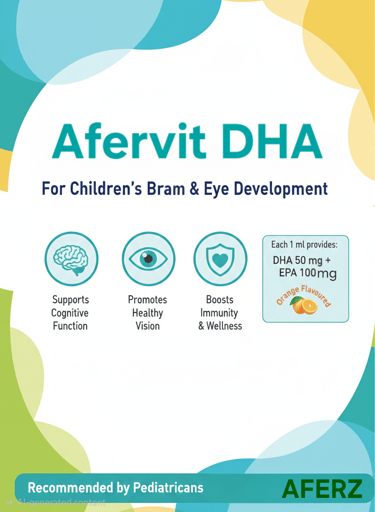
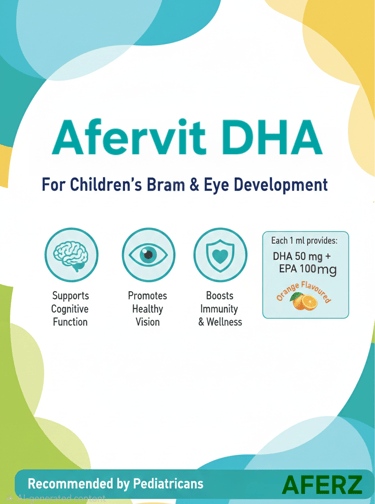
AFERVIT DHA Drops – Pediatric Nutritional Support
To address dietary gaps safely and effectively, Al Haider Healthcare recommends Aferz Pediatric Brand – AFERVIT DHA Drops.
Each 1 ml Contains:
DHA 50 mg & EPA 100 mg – Supports brain development, cognitive function, and vision
Vitamin D3 (400 IU) – Aids calcium absorption and promotes healthy bones and teeth
Calcium (50 mg) – Supports skeletal growth
Iron (5 mg) – Helps in hemoglobin formation and cognitive development
Zinc (2.5 mg) – Enhances immunity and growth
L-Lysine (30 mg) – Supports growth and protein utilization
L-Glutamic Acid (100 mg) – Contributes to brain and nerve function
Vitamin A Palmitate, Vitamin E, and B-Complex Vitamins (B1, B2, B3, B6, B12) – Support immunity, energy metabolism, and overall vitality
Lycopene (5 mg) – Provides antioxidant protection
Benefits of AFERVIT DHA Drops
✔ Supports brain growth and cognitive development
✔ Enhances learning and attention
✔ Promotes eye and retinal health
✔ Supports immune balance and daily wellness
✔ Easy-to-use, child-friendly liquid formulation
AFERVIT DHA Drops are especially beneficial for:
Toddlers with low fish intake
Vegetarian children
Children in rapid growth and learning phases
📝 Key Takeaways for Parents
DHA is essential for early brain and learning development
Many children do not get enough DHA from diet alone
Supplementation helps ensure consistent intake during critical growth years
AFERVIT DHA Drops provide a safe and evidence-based pediatric DHA solution
References
World Health Organization (WHO)
Fats and Fatty Acids in Human Nutrition – Expert Consultation
👉 https://www.who.int/publications/i/item/WHO-NMH-NHD-03.3FAO / WHO Joint Expert Consultation
Dietary fats and fatty acids in human nutrition
👉 https://www.fao.org/3/i1953e/i1953e.pdfAmerican Academy of Pediatrics (AAP)
Lipids and Nutrition in Infant Feeding – Pediatrics
👉 https://publications.aap.org/pediatrics/article/131/3/e827/31006American Academy of Pediatrics (AAP)
Dietary Recommendations for Children and Adolescents
👉 https://publications.aap.org/pediatrics/article/117/2/544/68400Centers for Disease Control and Prevention (CDC)
Second National Report on Biochemical Indicators of Diet and Nutrition
👉 https://stacks.cdc.gov/view/cdc/37900ICMR – National Institute of Nutrition (NIN), India
Dietary Guidelines for Indians
👉 https://www.nin.res.in/dietaryguidelines/pdfjs/locale/DGI07052024P.pdfEuropean Food Safety Authority (EFSA)
Scientific Opinion on EPA and DHA Intake
👉 https://www.efsa.europa.eu/en/efsajournal/pub/3760Innis SM.
Dietary Omega-3 Fatty Acids and the Developing Brain – Journal of Nutrition
👉 https://academic.oup.com/jn/article/137/4/855/4664622
🧠 What is DHA and Why Is It Important?
DHA (Docosahexaenoic Acid) is a major structural component of:
Brain cell membranes
Retina of the eye
Central nervous system
The World Health Organization (WHO) and the American Academy of Pediatrics (AAP) recognize DHA as an essential long-chain polyunsaturated fatty acid required for optimal neurological and visual development during infancy and early childhood.
Since the human body cannot synthesize sufficient DHA on its own, it must be obtained through dietary sources or supplementation.
© 2025. All rights reserved.
Subscribe to our newsletter
Contact Us
Visit Al Haider Healthcare for primary healthcare services and expert medical care.
Location
Semri-Sathi, West Champaran, Bihar, India 845449
Hours
OPD 9 AM - 9 PM
24*7 Emergency Sevice
Mob;
alhaiderhealthcare@gmail.com
+91-9060198636
Email;
www.ahchospital.in
Web;