
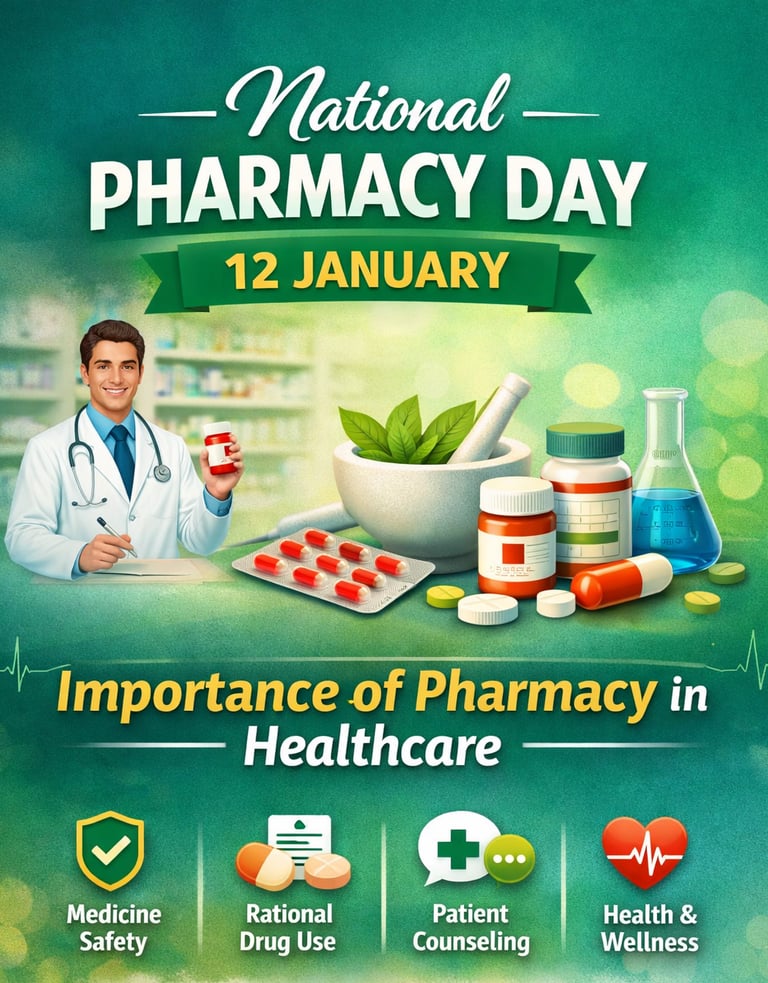
National Pharmacy Day – 12 January
In simple terms, pharmacy ensures that:
The right medicine
In the right dose
Is given to the right patient
At the right time
Through the right route
Pharmacy is both a science and an art—the science of medicines and the art of patient-centered care.
Who Is a Pharmacist?
A pharmacist is a trained healthcare professional who specializes in medicines. Pharmacists are not just medicine sellers; they are medicine experts who:
Interpret prescriptions
Check for drug interactions
Counsel patients on correct drug use
Ensure medicine quality and safety
Guide patients on side effects and precautions
Pharmacists work closely with doctors, nurses, and other healthcare professionals to ensure optimal treatment outcomes.
Branches of Pharmacy
Pharmacy is a vast field with multiple specialized branches:
1. Community Pharmacy
Community pharmacists work in retail medical stores and healthcare centers. They are often the first point of contact for patients.
Key roles:
Dispensing medicines
Patient counseling
Promoting rational drug use
Preventing misuse of antibiotics and painkillers
2. Hospital Pharmacy
Hospital pharmacists are integral to inpatient care.
Key roles:
Managing hospital drug supply
Preparing sterile formulations
Monitoring drug therapy
Preventing medication errors
3. Clinical Pharmacy
Clinical pharmacists work directly with doctors and patients.
Key roles:
Reviewing treatment plans
Adjusting doses in kidney/liver disease
Monitoring adverse drug reactions
Improving therapeutic outcomes
4. Pharmaceutical Industry
This branch focuses on drug discovery, manufacturing, and quality assurance.
Key roles:
Drug formulation and development
Quality control and quality assurance
Research and innovation
Regulatory compliance
5. Pharmacovigilance
This field deals with drug safety after marketing.
Key roles:
Monitoring side effects
Reporting adverse drug reactions
Ensuring long-term medicine safety
Importance of Pharmacy in Healthcare
1. Ensuring Medicine Safety
Pharmacy ensures that medicines are:
Properly stored
Not expired
Free from contamination
Used safely
Without pharmacy, medication errors and drug-related complications would rise dramatically.
2. Promoting Rational Use of Medicines
Irrational use of drugs—especially antibiotics—leads to antimicrobial resistance, a major global threat. Pharmacists play a key role in preventing this.
3. Patient Education and Counseling
Many treatment failures occur due to:
Incorrect dosage
Skipping medicines
Stopping treatment early
Pharmacists educate patients on:
How to take medicines
Duration of treatment
Possible side effects
Lifestyle modifications
4. Supporting Doctors and Healthcare Teams
Pharmacists assist doctors by:
Providing updated drug information
Suggesting safer alternatives
Preventing drug interactions
Ensuring cost-effective therapy
5. Public Health and Preventive Care
Pharmacy contributes to:
Vaccination programs
Health awareness campaigns
Chronic disease management
Maternal and child healthcare
Role of Pharmacy in Emergency and Critical Care
In emergency settings, pharmacy ensures:
Availability of life-saving drugs
Correct emergency doses
Rapid preparation of injections
Safe use of high-risk medicines
In ICU and NICU setups, pharmacy support is life-critical.
Pharmacy and Traditional Medicine
In India, pharmacy also supports Ayurveda, Unani, Siddha, and Herbal systems by:
Standardizing formulations
Ensuring quality and purity
Promoting evidence-based use
Integrating traditional medicine with modern healthcare
Challenges in Pharmacy Practice
Despite its importance, pharmacy faces challenges such as:
Self-medication
Over-the-counter misuse
Antibiotic resistance
Lack of patient awareness
These challenges highlight the need for stronger pharmacy education and regulation.
Why National Pharmacy Day Matters
National Pharmacy Day is observed to:
Honor pharmacists and pharmacy professionals
Spread awareness about medicine safety
Educate the public on rational drug use
Strengthen the healthcare system
It reminds us that medicines save lives only when used correctly.
Message from Al Haider Healthcare
At Al Haider Healthcare, we recognize pharmacy as a backbone of patient care. We are committed to:
Ethical medical practice
Rational use of medicines
Patient education and safety
Integrative healthcare for all age groups
On this National Pharmacy Day, we salute all pharmacists for their dedication, knowledge, and silent service to humanity.
Conclusion
Pharmacy is not just a profession—it is a responsibility toward life and health. From prevention to cure, from diagnosis to recovery, pharmacy plays a vital role at every step of healthcare.
Let us respect medicines, trust science, and promote responsible healthcare practices—for a healthier society.
Happy National Pharmacy Day – 12 January
Al Haider Healthcare – Committed to Care, Knowledge, and Compassion
Understanding Pharmacy and Its Vital Role in Healthcare
Every year on 12 January, India observes National Pharmacy Day to recognize the indispensable role of pharmacists and the science of pharmacy in safeguarding public health. Pharmacy is not merely about dispensing medicines; it is a critical pillar of the healthcare system that ensures the safe, effective, and rational use of drugs.
At Al Haider Healthcare, we believe that awareness and education are the foundations of good health. On this National Pharmacy Day, let us understand what pharmacy truly is, why it is important, and how pharmacists contribute silently yet significantly to patient care.
What Is Pharmacy?
Pharmacy is a branch of health sciences that deals with the preparation, dispensing, storage, quality control, and appropriate use of medicines. It bridges the gap between medical science and patient care, ensuring that prescribed drugs are safe, effective, and used correctly.